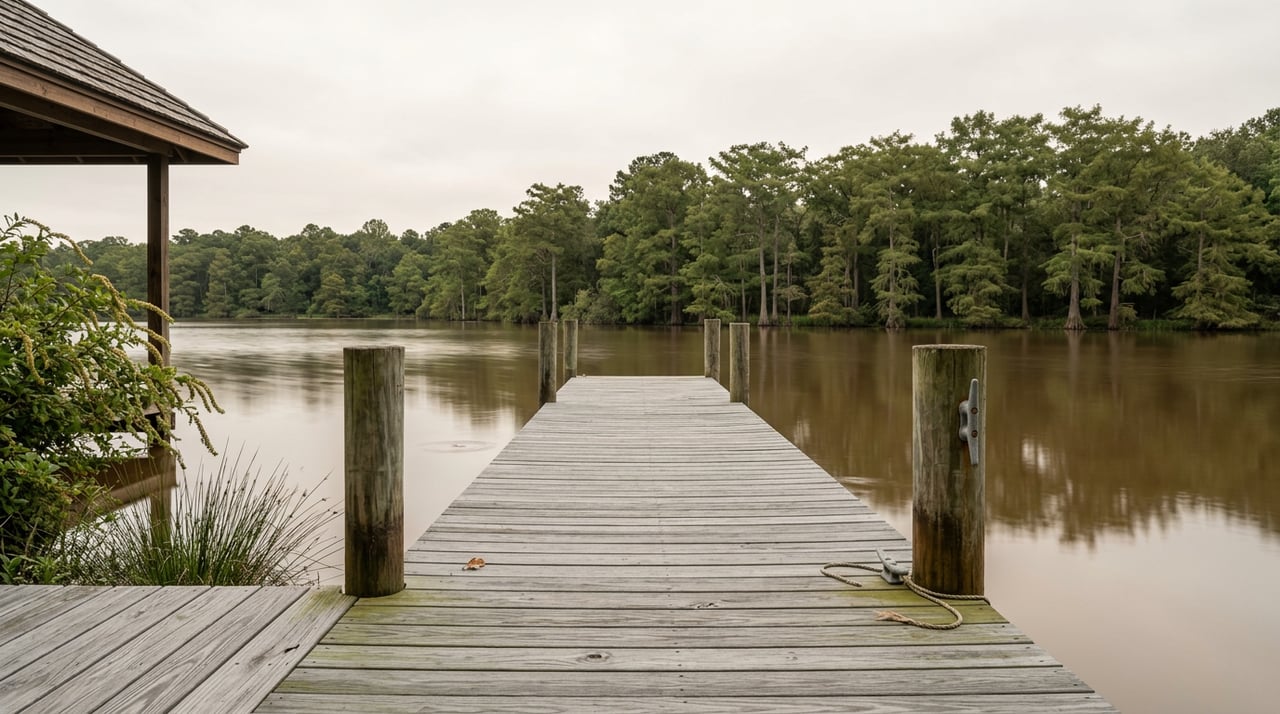
The morning of closing, most Cornelius waterfront buyers walk down to the dock one last time. It is usually the reason they wrote the offer in the first place: the pontoon slip, the covered platform, the view down the cove toward the main channel. What they are looking at, though, is not simply part of the house. It is a structure sitting on land Duke Energy still owns, held up by a permit that has to be reissued in the buyer's name before it is legally theirs to use.
That distinction rarely comes up during showings. It tends to surface later, sometimes at the closing table itself, when a title company or attorney asks a question nobody prepared for: is this permit actually in the seller's name, and has anyone started the transfer?
The Permit Runs With Duke's License, Not the Deed
Lake Norman exists because Duke Energy built it. The company operates the reservoir under a federal license, and that license is why a dock, pier, or seawall on the lake is never simply real property the way a deck or a fence is. It is a separately permitted structure, and Duke's own process for moving that permit into a new owner's name is specific.
Duke requires applications to transfer a permit to be submitted online through its Lake Access Permit System, and a Lake Services representative inspects the structure as part of that transfer to confirm it matches what was originally approved. If the inspector finds something that was never authorized, correcting it becomes the responsibility of whoever owns the property at that point, which after closing is the buyer.
That last detail is the one that catches people off guard. A seller who added a covered roof or extended a walkway years ago, without realizing that changed the footprint enough to need a new sign-off, has effectively handed that compliance gap to the next owner. Duke's language on this is direct: the representative inspects "to confirm it was properly permitted and has not been modified without Duke Energy's approval."
Why Cornelius Adds a Second Gate
Where the process gets more involved is on the Mecklenburg County side of the lake, and Cornelius sits squarely in that jurisdiction. A dock isn't just a Duke Energy matter here. The Town of Cornelius treats docks and piers as structures requiring their own building permit, and every application for one gets routed through Mecklenburg County's online system, with the Cornelius Planning Department automatically notified to perform a zoning review before the permit can move forward. Until that review clears, the application sits in what the town calls a deferred status.
That review isn't free, and the fee just changed. As of July 1, 2026, Cornelius updated its planning fee schedule: the zoning review fee for docks, piers, interior upfits, and demolitions is now $10, while most other building permits run $25. It's a small number, but it's a real second checkpoint that a comparable transaction on the other side of the lake simply doesn't have to clear.
Here's how the two sides of Lake Norman compare for a typical dock-related closing:
| Step | Mooresville / Iredell County side | Cornelius / Mecklenburg County side |
|---|---|---|
| Governing permit for the dock structure | Duke Energy Lake Services | Duke Energy Lake Services |
| Local building/zoning review | County-level, generally one layer | Town of Cornelius zoning review, routed through Mecklenburg County's permitting system |
| Fee for a standard dock or pier review | Varies by county | $10 town zoning review fee (effective July 1, 2026) |
| Permit status while under review | Standard county queue | Held in deferred status until Cornelius completes zoning review |
A buyer moving from a Mooresville listing to a Cornelius one, or vice versa, is often surprised that the same lake produces a different closing checklist depending on which shoreline they're standing on.
What a Missing Signature Costs You at the Closing Table
The most expensive version of this problem doesn't involve construction at all. It involves paperwork that was never finished.
Duke will only release a dock's full permitting history to the person currently listed as the permit holder. If the seller bought the home years ago and never formally transferred the permit into their own name, that history stays locked until someone completes the transfer, which means the seller has to fix their own paperwork gap before a buyer can even see what they're inheriting. That single missed step, often from a purchase a decade earlier, can stall a due diligence period that was otherwise moving smoothly.
For sellers, the fix is simple and worth doing before a home ever goes live: confirm the permit is in your name, not the name of whoever sold it to you. For buyers, it means asking the question early rather than assuming a plate on the dock and a nice photo in the listing mean the paperwork is settled.
The Buffer Isn't Just Duke's Rule
Duke's shoreline authority stops at the water's edge in a legal sense, but Cornelius layers its own zoning on top of that. The town's Land Development Code sets a rear setback for accessory structures of at least ten feet, with an explicit exception for whatever the Lake Norman buffer requirement on a given lot happens to be, whether that's spelled out in the town's Table of Dimensional Requirements or on the recorded plat itself.
That buffer isn't uniform. Cornelius's own guidance for property owners states plainly that every lakefront lot carries an undisturbed buffer requirement, and that the buffer differs from neighborhood to neighborhood and sometimes lot to lot, with the recorded plat as the first place to check. Where no buffer is noted on the plat, the rear setback defaults to whichever is greater: the undisturbed buffer or 25 feet from the rear property line.
New construction on Lake Norman lots inside Cornelius also falls under the town's Lake Norman Overlay District, which caps density and built-upon area for new development and calculates that built-upon area using the lake's 760-foot contour line as the boundary. None of this replaces Duke's review. It runs alongside it, and Mecklenburg County's own storm water ordinances add a third layer covering floodplain protection and erosion control for land development within town limits.
Before You List, or Make an Offer
A short list, either direction:
- Confirm the dock permit is currently in the seller's name, not a prior owner's, before the property goes on the market.
- Pull the recorded plat and check it for a noted buffer or setback line specific to that lot.
- Ask whether any dock modifications, covers, or platform changes happened without a matching permit update.
- Build in time for the Cornelius zoning review on top of Duke's transfer review. They run on separate clocks.
- If the property includes a shared or common-access structure rather than a single private dock, ask whether that structure required review by the Lake Norman Marine Commission in addition to Duke and the town.
Frequently Asked Questions
Does the dock permit automatically come with the house when I close? No. The deed transfers the real property. The dock's Duke Energy permit is a separate approval that has to be moved into the new owner's name through Duke's own transfer process, which includes an inspection.
How long does the Cornelius zoning review add to a dock permit application? The town holds the application in deferred status until its review is complete, which runs in addition to whatever timeline Duke's Lake Services team needs for the transfer and inspection.
What if the seller never transferred the permit into their own name after their purchase? Duke will not release the dock's permitting history to anyone whose name isn't on the permit, so that gap has to be closed first, which can add time to a due diligence period if it's discovered late.
A dock on Lake Norman is one of the best reasons to fall in love with a home in Cornelius. It's also one of the few features in a transaction that comes with its own separate approval process, sitting quietly behind the listing photos until someone asks the right question at the right time. If you're weighing a waterfront purchase or getting ready to list one, Nicole Henriksen and the LKN Elite Real Estate Group can walk through what's actually on file for a specific dock before it becomes a surprise at the closing table. Schedule a consultation to start there.