In early May, the Cornelius Police Department's lake patrol got 24 calls to help boats that had run aground, mostly near islands and shoal markers. In a normal summer the patrol averages fewer than five calls a month. Officer Scott Minderlein told Cornelius Today in June, "Lake Norman is a completely different lake during these drought conditions. Areas that were previously safe to navigate are no longer safe."
For anyone buying or selling on the water, the changed lake has a practical side. When the lake is full, a waterfront listing shows a dock, a slip and a view. A long drought shows how much water sits under that dock once the lake pulls back, and whether a boat can still get from the slip to open water. This year the lake has made that visible all over Lake Norman, and the water is still low enough this winter for a buyer to see it on a showing.
Where the lake stands the week this posts
Duke Energy reports Lake Norman on a scale where 100 feet is normal full pond. At its November 10, 2026 update, Duke listed Lake Norman at 96.65 feet, about three and a third feet below full pond, with the basin at drought Stage 1. The current reading is on Duke's lake levels page, and it's worth checking on the day of any showing, because the number moves with the rain.
The direction has been good lately. On November 11, Lake Norman Publications reported that recent rainfall had improved conditions across the Catawba-Wateree basin, and that Mooresville, Lincoln County and Charlotte Water had lifted the mandatory water use restrictions they put in place in May. Conditions had been worsening since September 2025, after months of dry weather and below-average rainfall.
In August, Duke Energy water resources manager Brett Hartis told Cornelius Today that the Catawba River watershed had been trending toward drought since Hurricane Helene in October 2024. He described the groundwater as "bone dry" and said, "Right now, any of these rain events are like pouring water over a dry sponge." He also said, "It took a long time to get into this level of drought, and it will take a long time to get out of it." Over the summer, Lake Norman hovered around 95 feet, roughly 3.5 feet below its seasonal target.
For a buyer touring waterfront homes between now and early spring, that history matters. The lake has spent most of 2026 several feet below full, and Duke's own manager expects a slow recovery.
What this year showed at private docks and public ramps
Over the summer, the drought separated docks that keep their water from docks that lose it, and local businesses saw the effects directly.
In June, Cornelius Today checked in with lake-dependent businesses. Alex Kuz, owner of The Boat Doctor, which services boats in the water, said many boats had sat on dry land that spring and couldn't be serviced. He estimated a 400% increase in calls to fix trim systems and props damaged in shallow water. At the same time, Morningstar Marinas Crown Harbor in Cornelius was fully booked and had added dry-dock customers, as many private dock owners looked for somewhere to keep boats left beached at home.
So some private dock owners spent part of 2026 paying to store a boat somewhere else, while others kept boating from their own slips. In listing photos taken at full pond, those two kinds of docks can look the same.
The public ramps showed the same pattern. Ahead of Memorial Day weekend, WBTV reported dry shoreline patches and four closed ramps at Blythe Landing. On June 13, Queen City News reported that four of Blythe Landing's six ramps were closed, while the ramps at Ramsey Creek and Hager Creek were open. A boater there said shallow water had limited some routes. The same low water left some launch points working and closed others.
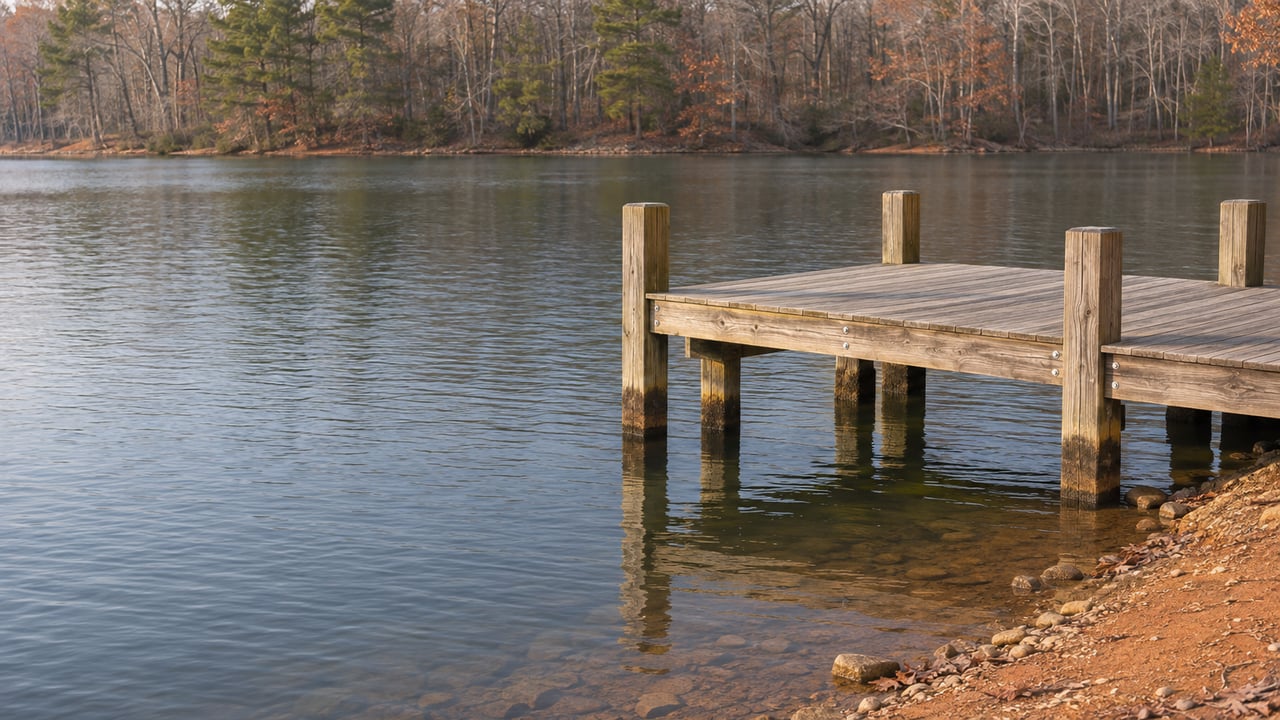
Private docks differ the same way, and a buyer sees the difference most clearly when the water is down. Lake Norman is down right now.
For buyers, the winter showing works as a depth test
At full pond, nearly every Lake Norman dock looks usable, so a summer showing tells you little about depth. A showing this winter tells you more.
First, write down the lake reading on the day you visit, so you know how far below full pond the water was when you saw the dock. Lake Norman sat around 95 feet for much of the summer, lower than the November reading, so ask how the dock did in May and June. Cornelius Today reported that summer levels three to four feet below target were last seen in 2002 and 2007, and that the historic summer low was 89.9 feet in 1970.
Second, ask the seller where the boat spent this summer. If it stayed in the slip, that is a strong fact in the dock's favor. If it went to dry storage at a marina, the seller has already learned the dock's limits, and you should hear about them before you write an offer.
Third, look past the end of the dock. Officer Minderlein warned boaters about point-to-point islands that can be crossed at higher water and about the areas near and between shoal signs. A slip with plenty of water still has to connect to the main channel. A boat ride from the property at low water shows you the route your boat will take, and the Boat Doctor's 400% jump in prop and trim repair calls shows what that route can cost if you get it wrong.
Depth is one of two separate questions about a dock. The other is the dock's paperwork, which we covered in our post on docks in Cornelius. A buyer weighing a deeded slip against a private dock can also read our look at the Cornelius waterfront premium, which looks at how lake access is priced in tiers.
For sellers, the low lake belongs in your listing plan
A waterfront seller listing this winter will show the dock at low water, so buyers will see the depth whether the seller brings it up or not. The sellers in the best position are the ones who already know how their dock did this year and can say so.
If the boat stayed in the water all summer, write that down now, with dates and the lake readings for those dates from Duke's page. A dated record of the boat staying in the slip this year is something a buyer comparing docks can check.
If the dock had trouble, the low water also gives a seller room to act. Cornelius Today reported that Decks and Docks, a Cornelius supplier of dock and seawall materials, had a customer that spring who named the low lake as the main reason to do dock repairs right away. Shoreline that the low water has exposed is easier to see, for the seller now and for a buyer's inspector later. Duke Energy says it owns or controls the lakebeds of its reservoirs, and its shoreline permits page is the official record for any work beyond the dock itself.
Frequently asked questions
Is 96.65 the lake's height above sea level? No. Duke Energy reports Lake Norman on a scale where normal full pond is 100 feet, so the November 10 reading of 96.65 means about three and a third feet below full.
Is the drought over? Not yet. Lake Norman Publications reported on November 11 that mandatory restrictions had been lifted, and that officials were still asking residents to conserve water voluntarily. Duke's Brett Hartis said in August that recovery would take sustained rainfall.
Does this apply only to Cornelius? No. The drought covers the whole Catawba-Wateree basin, and the November level reading is for all of Lake Norman. That includes the shorelines of Mooresville, Davidson, Denver and Cornelius. Most of the on-the-water accounts above came from Cornelius police and businesses.
If you're touring waterfront homes this winter, or planning to list a lake home in the spring, LKN Elite Real Estate Group can walk the dock with you while the water is low and talk through what this year showed about it. Schedule a consultation through our contact page.